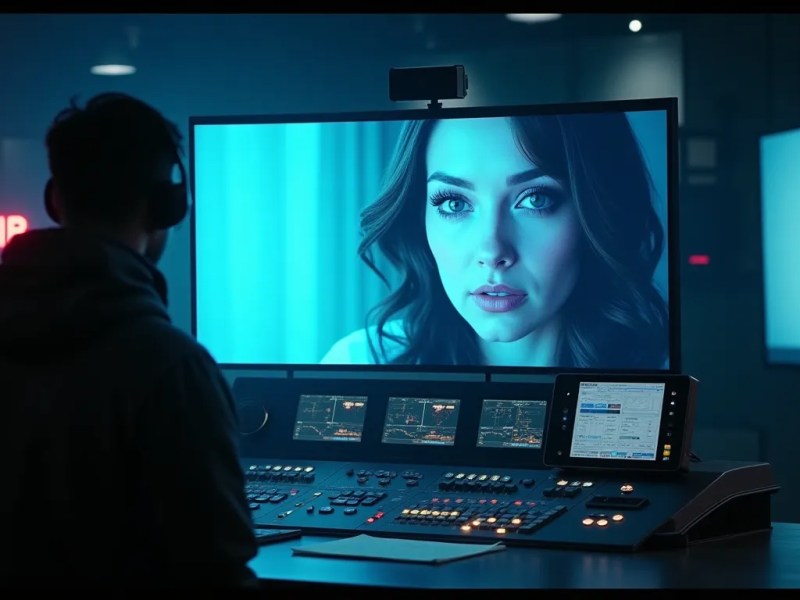
Tilly Norwood does not have a face that gets tired, hands that shake before a take, or an agent who negotiates for scale-plus-ten. It also does not have opinions. So when headlines this week reported that the AI performer “gave its first interview” and said it’s “not here to replace human actors,” what actually happened is a lot simpler than the coverage made it sound: a company wrote some reassuring lines, put them in the mouth of a synthetic character now cast in a real film role, and called it press.
That’s the part worth sitting with. Not whether Tilly Norwood is good or bad for the industry — plenty of people have strong feelings about that already — but whether calling this an “interview” is even accurate reporting. An interview implies a subject with something to say. Tilly Norwood is a product. The “answers” were generated or scripted by the studio behind it, for the studio’s benefit, to manage a controversy the studio itself created by casting a synthetic performer in the first place. That’s not news breaking. That’s a press release wearing a trench coat.
And a lot of outlets ran with it as if it were a genuine moment — an AI “opening up,” “addressing the backlash,” “responding to critics.” Those are verbs you use for a person. Using them for a line of code dressed up in a headshot blurs the actual story, which is straightforward: an entertainment company has cast an AI character in a paying acting role, real actors and their union are furious about what that means for human jobs, and now that same company is using the AI itself as a PR tool to cool down the anger. That’s the whole thing. It doesn’t need a “the AI speaks” angle to be interesting — it’s already interesting, and it’s already tense, because SAG-AFTRA and plenty of working actors have made clear they see this as exactly the kind of threat they fought to get protections against in the last contract cycle.
What’s missing from most of the coverage is any scrutiny of the claim itself. “Not here to replace humans” is doing a lot of work in that headline, and nobody seems to be asking the obvious follow-up: replace them how, exactly, and says who? Tilly Norwood didn’t decide anything. A company decided to cast a synthetic character in a job an actor could have booked, and then decided the smartest move was to have that same character say, in effect, “don’t worry, I’m not taking your job” — while literally taking a job. Reporting that quote at face value, without flagging who wrote it and why, isn’t neutral. It’s stenography for a PR strategy.
It’s also worth being honest about what we don’t actually know yet. Availability and pricing for whatever “casting” Tilly Norwood is even a straightforward transaction — licensing terms, union status, how future roles get built — are still thin on details. There’s no independent hands-on read yet on how this performance actually holds up next to a working actor’s, no outside evaluation of quality beyond what the company itself has shown. So the “she’s not replacing anyone” framing is unverified on two levels: we don’t know if the claim is sincere, and we don’t know if the underlying product is even good enough to make the claim relevant. Straightforward reporting would say that plainly instead of letting a quote from a manufactured mouth stand in for an actual finding.
None of this requires taking a side on whether AI performers belong in film. That’s a real debate, and it’s going to keep happening whether anyone likes it or not. But there’s a difference between covering that debate and getting recruited into a company’s messaging because the messaging came from a novelty — an AI “speaking for itself.” The novelty is the hook. It shouldn’t be the substance. If a studio wants to reassure actors and audiences that it’s not trying to automate people out of their careers, it can say so in its own name, on the record, and take the questions that follow. Handing the mic to the product it built is not an interview. It’s a script. The job of the press is to say so, not to publish it as if the character meant it.
FAQ
Did the AI actor Tilly Norwood really give an interview?
No. Tilly Norwood is a synthetic character with no independent thoughts. The ‘interview’ quotes were written or generated by the company behind the character to manage backlash over casting an AI performer in a paid acting role.
Why are actors and SAG-AFTRA concerned about AI performers like Tilly Norwood?
SAG-AFTRA and working actors see synthetic performers cast in real roles as a direct threat to human employment, an issue the union specifically fought to address in its most recent contract negotiations.
Sources
Related